Building Safety Nets in Gajuwaka
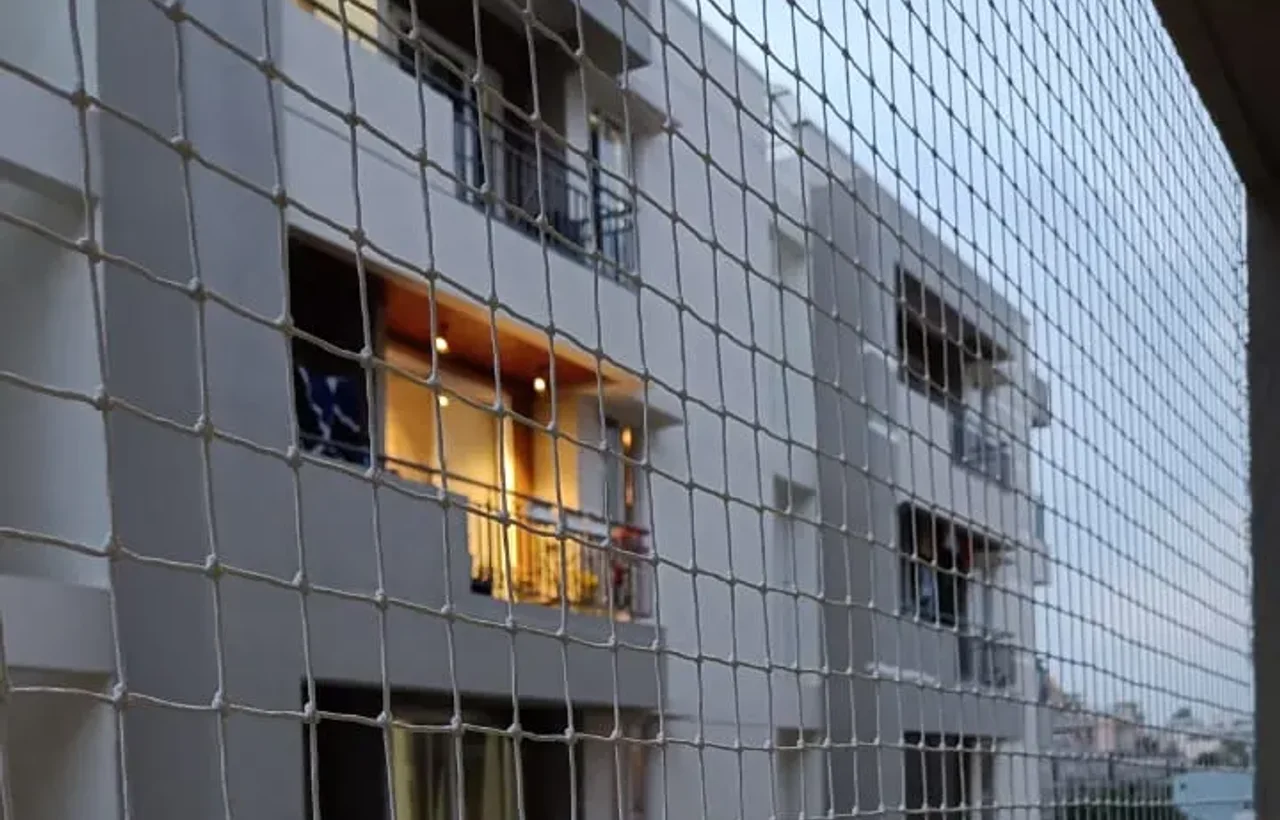
Full-elevation netting for apartment blocks — glass protection, debris containment and bird exclusion in one install.
Fitting this in Gajuwaka
Steel-plant industrial belt — airborne particulate and heavy industrial netting alongside domestic work.
Coarser mesh on residential balconies; fine mesh mats up within a season here.
On a tower, the problems compound: pigeons on every ledge, objects falling from upper balconies onto parked cars, and glazing exposed to whatever the monsoon throws at it. A full-elevation net addresses all three at once and costs less per square foot than treating each balcony separately.
We work with the association or builder, scaffold or rope-access as the elevation requires, and phase the work so residents are not without access.
- Priced per elevation, cheaper than per-balcony
- Rope access available — no scaffold cost on most towers
- Phased installation, residents keep balcony access
- Single point of contact for the association
- Annual inspection contract available
Specification
| Material | Heavy-gauge HDPE, UV stabilised |
|---|---|
| Mesh size | 50mm typical |
| Access | Rope access or scaffold |
| Suited to | Apartment blocks, commercial towers |
| Warranty | 5-year standard warranty, up to 10 years on HDPE installations |
| Covered in Gajuwaka | Kurmannapalem, Duvvada, Aganampudi |
Local conditions in Gajuwaka
- Industrial particulate. Coarser mesh on residential balconies; fine mesh mats up within a season here.
- Industrial contracts. Warehouse and godown exclusion on engineered cable grids, rather than domestic perimeters.
- Salt plus industry. Stainless fixings throughout — the combination is harder on hardware than either alone.
Building Safety Nets in Gajuwaka — common questions
Do you fit building safety nets across Gajuwaka?
Yes — Kurmannapalem, Duvvada, Aganampudi and the rest of the city, 3 localities in total. Site inspection is free and usually within 24–48 hours.
Does Gajuwaka need a different specification?
Steel-plant industrial belt — airborne particulate and heavy industrial netting alongside domestic work. Coarser mesh on residential balconies; fine mesh mats up within a season here.
What material are the nets made from?
Knotted high-density polyethylene, UV stabilised. HDPE is chemically inert, waterproof and does not degrade in sunlight the way untreated polypropylene does. Nets are tensioned on a stainless steel wire frame using screw pins, turnbuckles and hogging staples, so the installation stays tight rather than sagging after the first season.
How much does it cost?
Pricing starts from a base rate per square foot and varies by product — invisible grills cost several times more than netting. Use the estimate calculator for an approximate figure, then book a free site visit for an exact written quotation. Measurements taken over the phone are almost always wrong.
How long will the installation last?
Five years is typical for HDPE netting in direct sun, longer on sheltered elevations. Invisible grills last considerably longer — the stainless cable is the limiting component and it does not corrode. Sun exposure is what ages netting, not rain.
Building Safety Nets in Gajuwaka — get a price
Free inspection anywhere in Gajuwaka. We measure, recommend the right specification for local conditions, and quote in writing.